The Engineering Design Process
This process nurtures students’ abilities to create innovative solutions to challenges in any subject!
The engineering design process is a series of steps that guides engineering teams as we solve problems. The design process is iterative, meaning that we repeat the steps as many times as needed, making improvements along the way as we learn from failure and uncover new design possibilities to arrive at great solutions.
Overarching themes of the engineering design process are teamwork and design. Strengthen your students’ understanding of open-ended design as you encourage them to work together to brainstorm new ideas, apply science and math concepts, test prototypes and analyze data—and aim for creativity and practicality in their solutions. Project-based learning engages learners of all ages—and fosters STEM literacy.

Engineers ask critical questions about what they want to create, whether it be a skyscraper, amusement park ride, bicycle or smartphone. These questions include: What is the problem to solve? What do we want to design? Who is it for? What do we want to accomplish? What are the project requirements? What are the limitations? What is our goal?
This includes talking to people from many different backgrounds and specialties to assist with researching what products or solutions already exist, or what technologies might be adaptable to your needs.
You work with a team to brainstorm ideas and develop as many solutions as possible. This is the time to encourage wild ideas and defer judgment! Build on the ideas of others! Stay focused on topic, and have one conversation at a time! Remember: good design is all about teamwork! Help students understand the brainstorming guidelines by using the TE handout and two sizes of classroom posters.
For many teams this is the hardest step! Revisit the needs, constraints and research from the earlier steps, compare your best ideas, select one solution and make a plan to move forward with it.
Building a prototype makes your ideas real! These early versions of the design solution help your team verify whether the design meets the original challenge objectives. Push yourself for creativity, imagination and excellence in design.
Does it work? Does it solve the need? Communicate the results and get feedback. Analyze and talk about what works, what doesn't and what could be improved.
Discuss how you could improve your solution. Make revisions. Draw new designs. Iterate your design to make your product the best it can be.
And now, REPEAT!
Engineering-Design Aligned Curricula
Grades K-2
- Engineering an Animal’s Survival Engineering an Animal’s Survival
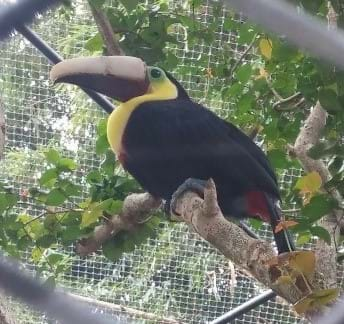
Students perform research and design prosthetic prototypes for an animal to use for its survival. They research a set of pre-chosen animals and their habitats. They then create habitats for their animals to live and model 3D prosthetics for the animals to use with modeling clay.
- Designing Musical Art to Help See Sound Designing Musical Art to Help See Sound

Students explore how sound is created. After researching with classmates, students are then challenged to create a prototype guitar. Using paint on the strings of their guitar, students create vibrations by plucking on the strings.
- Bacteria! It’s Everywhere! Bacteria! It’s Everywhere!
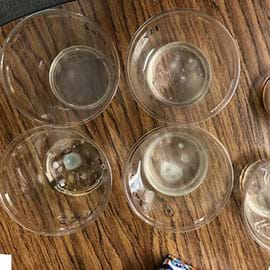
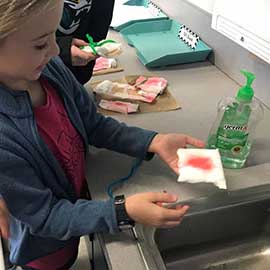
Students investigate what causes them to become sick during the school year. They use the engineering design process to test the classroom lab spaces for bacteria. After their tests, they develop ideas to control the spread of germs within the classroom.
- Stop Freewheeling Using Friction! Stop Freewheeling Using Friction!
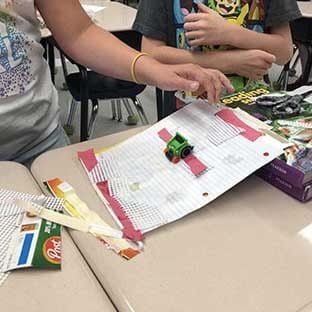
In this maker challenge, students use the engineering design process to design a covering for a portable wheelchair ramp for their school. The design must be easy to use, and allows people to move up the ramp easily and go down slowly.
- Invent a Backscratcher from Everyday Materials Invent a Backscratcher from Everyday Materials

Given scrap cardboard, paper towel tubes, scissors, and glue, how could a student invent their own backscratcher? Engage in the process of how real engineers design products to meet a desired function.
- See More
Grades 3-5
- Exploring Variables While Testing & Improving Mint-Mobiles (for Elementary School) Exploring Variables While Testing & Improving Mint-Mobiles (for Elementary School)

Build a model race car out of lifesaver candies, popsicle sticks, straws, and other fun materials! Have students learn about independent, dependent, and control variables, and find out who can make the fastest car given their new knowledge.
- Design and Fly a Kite Design and Fly a Kite

Students learn how to use wind energy to combat gravity and create lift by creating their own tetrahedral kites capable of flying. They explore different tetrahedron kite designs, learning that the geometry of the tetrahedron shape lends itself well to kites and wings because of its advantageous str...
- Design Your Own Snazzy Sneakers Design Your Own Snazzy Sneakers

For this maker challenge, students decide on specific design requirements (such as good traction or deep cushioning), sketch their plans, and then use a variety of materials to build prototype shoes that meet the design criteria.
- Cutting Through Soil Cutting Through Soil

Students pretend they are agricultural engineers during the colonial period and design a miniature plow that cuts through a "field" of soil. They are introduced to the engineering design process and learn of several famous historical figures who contributed to plow design.
- The Strongest Strongholds The Strongest Strongholds

Students work together in small groups, while competing with other teams, to explore the engineering design process through a tower building challenge. They are given a set of design constraints and then conduct online research to learn basic tower-building concepts. During a two-day process and usi...
- See More
Grades 6-8
- Oil: Clean It Up! Oil: Clean It Up!
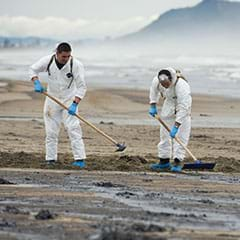
Student groups create and test oil spill cleanup kits that are inexpensive and accessible for homeowners or for big companies to give to individual workers—to aid in home, community or environmental oil spill cleanup process.
- Engineering in Reverse! Engineering in Reverse!

Students learn about the process of reverse engineering and how this technique is used to improve upon technology. Students analyze push-toys and draw diagrams of the predicted mechanisms inside the toys. Then, they disassemble the toys and draw the actual inner mechanisms.
- Three-Tower Types Challenge: Tower Investigation and the Egg Three-Tower Types Challenge: Tower Investigation and the Egg

In this activity, student groups design and build three types of towers (guyed or cable-supported, free-standing or self-standing, and monopole), engineering them to meet the requirements that they hold an egg one foot high for 15 seconds.
- Solar Sails: The Future of Space Travel Solar Sails: The Future of Space Travel

Working as if they were engineers, students design and construct model solar sails made of aluminum foil to move cardboard tube satellites through “space” on a string. Working in teams, they follow the engineering design thinking steps—ask, research, imagine, plan, create, test, improve—to design an...
- Water Bottle Rockets Water Bottle Rockets

Students are challenged to design and build rockets from two-liter plastic soda bottles that travel as far and straight as possible or stay aloft as long as possible. Guided by the steps of the engineering design process, students first watch a video that shows rocket launch failures and then partic...
- See More
Grades 9-12
- Bio-Engineering: Making and Testing Model Proteins Bio-Engineering: Making and Testing Model Proteins
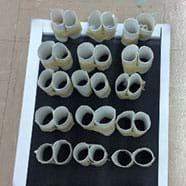
Students learn about human proteins, how their shapes are related to their functions and how DNA protein mutations result in diseases. Then, in a hypothetical engineering scenario, they use common classroom supplies to design and build their own structural, transport and defense protein models to he...
- Scrub the Scum, Save the Shine: Engineering Motor-Driven Brushes Scrub the Scum, Save the Shine: Engineering Motor-Driven Brushes

Students are challenged to design a motor-driven brushing tool that can successfully remove “scum” from a smooth surface while maintaining surface integrity (shine). Students are introduced to the concepts of surface tension, cohesion, adhesion, and friction as they investigate the effects of surfac...
- Pump It! Design-Build-Test Helpful Village Water Pumps Pump It! Design-Build-Test Helpful Village Water Pumps

In this hands-on activity, student groups design, build, test and improve devices to pump water as if they were engineers helping a rural village meet their drinking water supply. Students keep track of their materials costs, and calculate power and cost efficiencies of the prototype pumps.
- Designing Prototypes to Save Coral Reefs Designing Prototypes to Save Coral Reefs

Students are presented with the phenomenon of human activities killing coral reefs. They work in groups of 2-5 to create a prototype to help reduce the impact of coral loss from an assigned perspective (e.g., coral bleaching, tourism, pollution, overfishing/dredging). They should already have basic ...
- Balloons Balloons

Students follow the steps of the engineering design process as they design and construct balloons for aerial surveillance. Applying their newfound knowledge, the young engineers build and test balloons that fly carrying small flip cameras that capture aerial images of their school.
- See More